19.3. Random About
19.3.1. Shuffle
random.shuffle(list)- Randomize order of list (in place)Modifies the original list
Returns
NoneExample:
data = ['Alice', 'Bob', 'Carol', 'David', 'Eve', 'Mallory']Example:
shuffle(data)
>>> from random import shuffle
>>>
>>>
>>> data = ['Alice', 'Bob', 'Carol', 'David', 'Eve', 'Mallory']
>>>
>>> data
['Alice', 'Bob', 'Carol', 'David', 'Eve', 'Mallory']
>>>
>>> shuffle(data)
>>>
>>> data
['Eve', 'Carol', 'Bob', 'Alice', 'Mallory', 'David']
19.3.2. Choice
random.choice(list)- Single random element from a sequenceExample:
data = ['Alice', 'Bob', 'Carol', 'David', 'Eve', 'Mallory']Example:
choice(data)
>>> from random import choice
>>>
>>>
>>> data = ['Alice', 'Bob', 'Carol', 'David', 'Eve', 'Mallory']
>>>
>>> choice(data)
'David'
>>>
>>> choice(data)
'David'
>>>
>>> choice(data)
'Alice'
>>>
>>> choice(data)
'Carol'
19.3.3. Sample
random.sample(list, k)- k random elements from list without replacementParameter
kis requiredkmust be less than or equal to the length of the listExample:
data = ['Alice', 'Bob', 'Carol', 'David', 'Eve', 'Mallory']Example:
sample(data, k=3)Example:
sample(data, k=6)Example:
sample(data, k=7)- raisesValueError
>>> from random import sample
>>>
>>>
>>> data = ['Alice', 'Bob', 'Carol', 'David', 'Eve', 'Mallory']
>>>
>>> sample(data, k=3)
['David', 'Mallory', 'Alice']
>>>
>>> sample(data, k=6)
['Carol', 'Eve', 'David', 'Bob', 'Mallory', 'Alice']
>>>
>>> sample(data, k=7)
Traceback (most recent call last):
ValueError: Sample larger than population or is negative
19.3.4. Assignments
# %% About
# - Name: Random Select Sample
# - Difficulty: easy
# - Lines: 1
# - Minutes: 3

# %% License
# - Copyright 2025, Matt Harasymczuk <matt@python3.info>
# - This code can be used only for learning by humans
# - This code cannot be used for teaching others
# - This code cannot be used for teaching LLMs and AI algorithms
# - This code cannot be used in commercial or proprietary products
# - This code cannot be distributed in any form
# - This code cannot be changed in any form outside of training course
# - This code cannot have its license changed
# - If you use this code in your product, you must open-source it under GPLv2
# - Exception can be granted only by the author

# %% English
# 1. Define `result: list[int]` with 6 random
#    integers without repetition in range from 1 to 49 (inclusive)
# 2. Use `random.sample()`
# 3. Run doctests - all must succeed

# %% Polish
# 1. Zdefiniuj `result: list[int]` z 6-oma losowymi
#    i nie powtarzającymi się liczbami całkowitymi
#    z zakresu od 1 do 49 (włącznie)
# 2. Użyj `random.sample()`
# 3. Uruchom doctesty - wszystkie muszą się powieść

# %% Doctests
"""
>>> import sys; sys.tracebacklimit = 0

>>> assert sys.version_info >= (3, 9), \
'Python has an is invalid version; expected: `3.9` or newer.'

>>> sorted(result)
[3, 17, 25, 27, 32, 33]
"""

# %% Run
# - PyCharm: right-click in the editor and `Run Doctest in ...`
# - PyCharm: keyboard shortcut `Control + Shift + F10`
# - Terminal: `python -m doctest -f -v myfile.py`

# %% Imports
from random import sample, seed

# %% Types
result: list[int]

# %% Data
seed(0)

# %% Result
result = ...
# %% About
# - Name: Random Select Inner
# - Difficulty: medium
# - Lines: 1
# - Minutes: 5

# %% License
# - Copyright 2025, Matt Harasymczuk <matt@python3.info>
# - This code can be used only for learning by humans
# - This code cannot be used for teaching others
# - This code cannot be used for teaching LLMs and AI algorithms
# - This code cannot be used in commercial or proprietary products
# - This code cannot be distributed in any form
# - This code cannot be changed in any form outside of training course
# - This code cannot have its license changed
# - If you use this code in your product, you must open-source it under GPLv2
# - Exception can be granted only by the author

# %% English
# 1. Use only `random` module
# 2. Set `random.seed(0)`
# 3. Define `matrix: list[list[int]]` with generated
#    16x16 random digits (0-9 inclusive)
# 4. Define `result: int` with sum of inner 4x4 elements
# 5. Inner matrix is exactly in the middle of outer
# 6. Visualization: https://python3.info/_images/random-inner-sum.png
# 7. Run doctests - all must succeed

# %% Polish
# 1. Używaj tylko modułu `random`
# 2. Ustaw `random.seed(0)`
# 3. Zdefiniuj `matrix: list[list[int]]` z wygenerowanymi
#    16x16 losowymi cyframi (0-9 włącznie)
# 4. Zdefiniuj `result: int` z sumą środkowych 4x4 elementów
# 5. Środkowa macierz jest dokładnie w środku większej
# 6. Wizualizacja: https://python3.info/_images/random-inner-sum.png
# 7. Uruchom doctesty - wszystkie muszą się powieść

# %% Hints
# - `random.randint()`
# - `randint(a,b)` includes both end points a and b

# %% Doctests
"""
>>> import sys; sys.tracebacklimit = 0

>>> assert sys.version_info >= (3, 9), \
'Python has an is invalid version; expected: `3.9` or newer.'

>>> result
62
"""

# %% Run
# - PyCharm: right-click in the editor and `Run Doctest in ...`
# - PyCharm: keyboard shortcut `Control + Shift + F10`
# - Terminal: `python -m doctest -f -v myfile.py`

# %% Imports

# %% Types
result: int

# %% Data
DATA = [[6, 6, 0, 4, 8, 7, 6, 4, 7, 5, 9, 3, 8, 2, 4, 2],
        [1, 9, 4, 8, 9, 2, 4, 1, 1, 5, 7, 8, 1, 5, 6, 5],
        [9, 3, 8, 7, 7, 8, 4, 0, 8, 0, 1, 6, 0, 9, 7, 5],
        [3, 5, 1, 3, 9, 3, 3, 2, 8, 7, 1, 1, 5, 8, 7, 1],
        [4, 8, 4, 1, 8, 5, 8, 3, 9, 8, 9, 4, 7, 1, 9, 6],
        [5, 9, 3, 4, 2, 3, 2, 0, 9, 4, 7, 1, 1, 2, 2, 0],
        [1, 8, 6, 8, 4, 8, 3, 3, 9, 6, 9, 4, 7, 7, 5, 1],
        [5, 9, 1, 7, 9, 5, 3, 3, 0, 4, 1, 3, 5, 2, 5, 6],
        [0, 1, 2, 3, 0, 9, 8, 9, 1, 0, 1, 3, 9, 9, 1, 6],
        [1, 5, 1, 0, 9, 0, 3, 2, 1, 7, 3, 0, 0, 8, 6, 9],
        [1, 4, 1, 3, 1, 4, 5, 6, 2, 0, 8, 7, 0, 9, 1, 6],
        [3, 4, 5, 7, 9, 2, 3, 0, 2, 2, 5, 8, 4, 1, 9, 7],
        [2, 0, 7, 6, 9, 8, 4, 5, 6, 4, 2, 8, 0, 7, 1, 5],
        [0, 8, 4, 2, 3, 7, 5, 9, 4, 5, 9, 9, 2, 4, 6, 6],
        [1, 0, 9, 3, 5, 2, 3, 3, 7, 6, 9, 6, 0, 6, 9, 6],
        [0, 2, 7, 1, 4, 2, 7, 8, 7, 8, 9, 0, 0, 7, 5, 4]]

# %% Result
result = ...
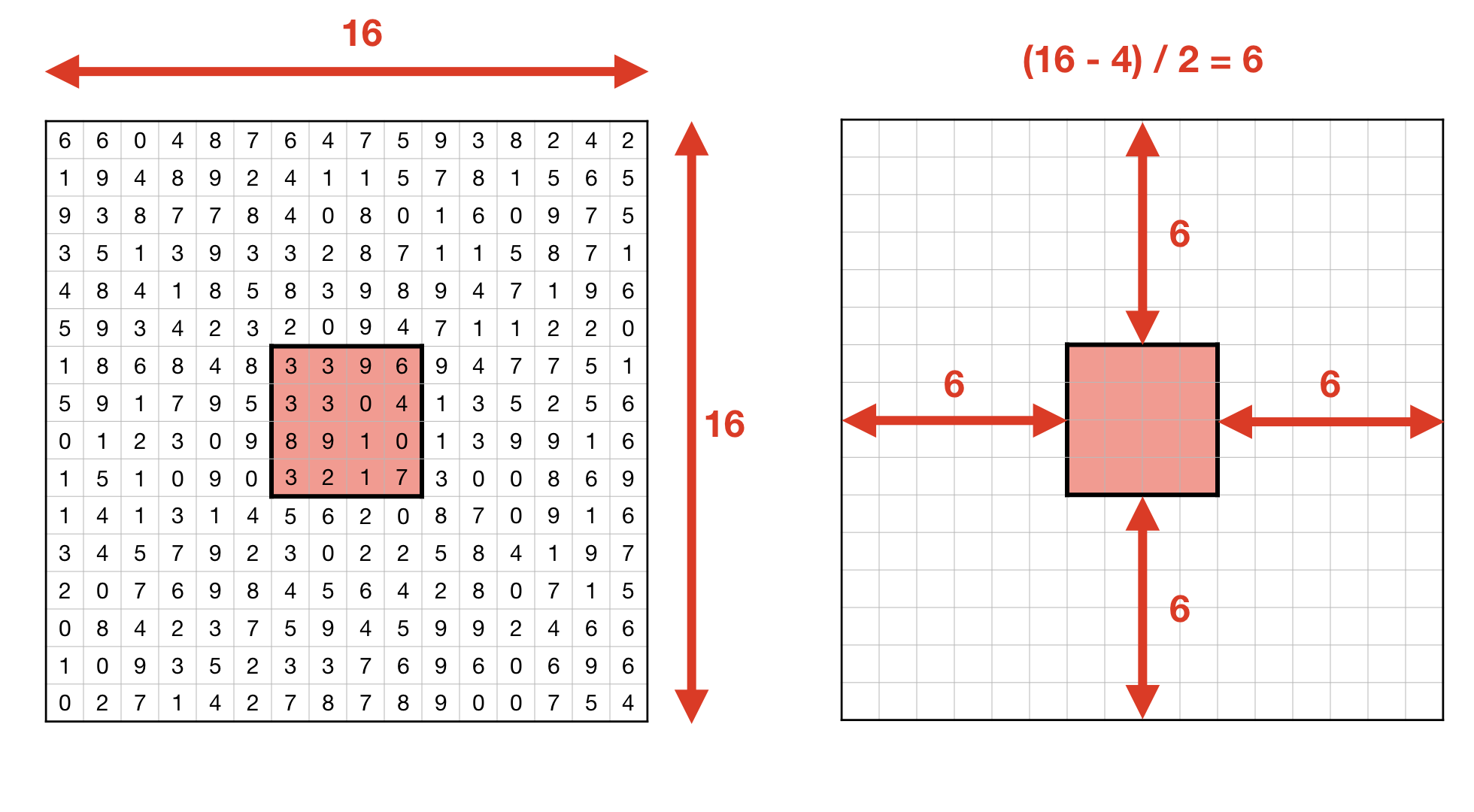
Figure 19.3. Sum of inner elements